
What are MOOCs and Can I Earn Credit?

Wikipedia defines a MOOC as:laptop home

A massive open online course (MOOC) is a type of online course aimed at large-scale participation and open access via  web. MOOCs are a recent development in the area of distance education, and a progression of the kind of open education ideals suggested by open educational resources.Though the design of and participation in a MOOC may be similar to college or university courses, MOOCs typically do not offer credits awarded to paying students at schools. However, assessment of learning may be done for certification.While there is no commonly accepted definition of a MOOC, two key features seem prevalent:

  • Open access. MOOC participants do not need to be a registered student in a school to “take” a MOOC, and are not required to pay a fee.
  • Scalability. Many traditional courses depend upon a small ratio of students to teacher, but the “massive” in MOOC suggests that the course is designed to support an indefinite number of participants.pedi

Scott Jaschik of InsideHigherEd.com shares breaking news about MOOCs.

Two announcements this week suggest that MOOCs — massive open online courses — will increasingly include a route for students to receive academic credit. Read the breaking news by clicking here.


Do I Need to Take the S.A.T Subject Tests?

SAT Subject Tests were developed by the College Board to measure the student’s knowledge or skills in a certain area such as math, history, physical science, literature, and foreign language.  These tests can be taken at any point in the student’s junior or senior year as long as they have completed the related course work in that subject area.

Many colleges use the SAT Subject Tests for admission, for course placement, and to advise students about course selection. Some colleges specify the SAT Subject Tests that they require for admission or placement; others allow applicants to choose which tests to take.  If you are presently taking an Advanced Placement course in one of the areas listed below, you may want to consider taking the Subject Test in that topic in May or June since you are already studying for the AP test. Click here for list of Subject Tests offered.

What is Double Depositing? Is it an Ethical Option?

The clock is ticking down and the April 1st has arrived. High school seniors across the country are checking their email and mailboxes for the admissions decisions from the college they applied to. Many students may receive more than one acceptance. The stress and the cost of college is a major decision, so for students who cannot make up their mind where to go, they may consider double depositing.

What is the definition of double depositing? Double depositing means putting down a deposit, and thus accepting admission, at more than one college.

I often hear, “This decision is not easy!” Or “I love all my schools for different reasons.” Student re-visit their colleges and look to teachers and friends (and even parents) for guidance. So what do they do? Sending a non-refundable enrollment deposit check can cost as little as $100, while at others it can be as much as $500 or $1,000 can be costly, but the student just can’t decide. Read more about the Double Depositing and ethical issues surrounding it.

Over 1000 Families Reading eBook – Your College Planning Survival Guide!

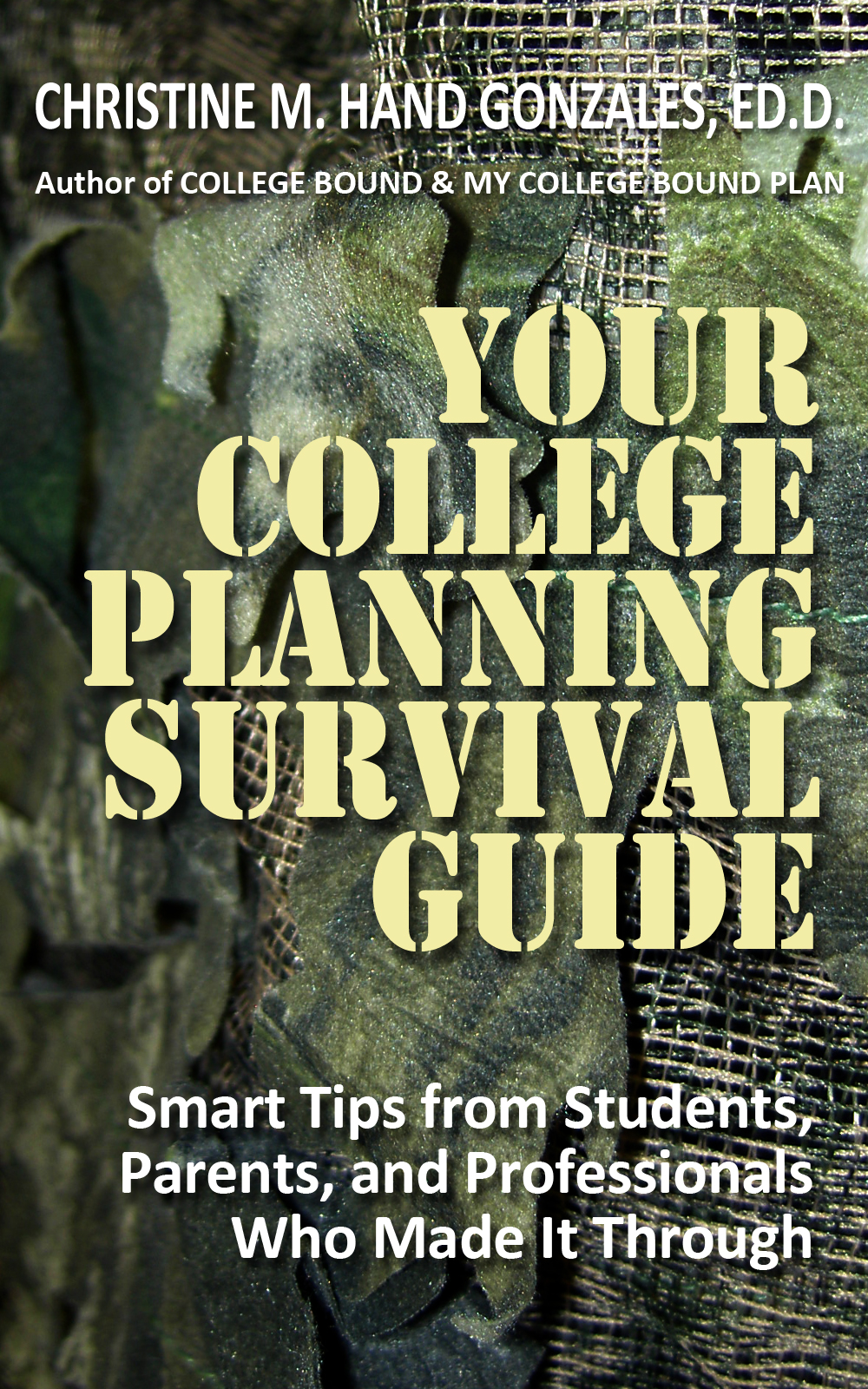
Ebook or paperback – which is your preference? More and more people are turning to electronic versions of books for their reading pleasure. This week over 1,000 people downloaded “Your College Planning Survival Guide: Smart Tips From Students, Parents, and Professionals Who Made It Through.” I hope they found it enlightening and useful. Reviews indicate the information offered in this guide equate to having a professional college counseling  consultant at your fingertips – it answers all your questions regards to college planning process.

Amazon ranks this Kindle eBook edition #1 in “Educational Reference” category for “High School” and “Parent Participation.” If you are one of the thousand plus readers, please offer a review on Amazon if you found it helpful and share your knowledge!

For those that still prefer holding a book in your hands, highlighting the important tips, and making notes to yourself in the margins, you will find this book is also available in paperback.  Happy Reading!

Link to Amazon books – click here! Also available in paperback!

What Types of Standardized Tests are Used in College Admissions?

Thinking ahead to standardized admissions testing for the college application? There are several types of standardized tests used for college admissions. Each one has a purpose and these tests give the college admissions representatives an idea of the student’s college readiness.  The admissions committee will often look at these scores in conjunction with the grade point average and rigor of courses taken by the student. The tests are the SAT, SAT Subject Test, ACT with Writing, TOEFL, and AP (Advanced Placement Tests). This link reveals an excellent comparison between the New SAT and the ACT – https://collegereadiness.collegeboard.org/sat/inside-the-test/compare-new-sat-act.

SAT Reasoning Test is a standardize test which measures a student’s verbal and mathematical aptitude as well as writing skills. Score range is 600-2400.

SAT Subject Tests were developed by the College Board to measure the student’s knowledge or skills in a certain area such as math, history, physical science, literature, and foreign language.  These tests can be taken at any point in the student’s junior or senior year as long as they have completed the related course work in that subject area.

ACT with Writing is also taken nationally like the SAT. It focuses on English usage, mathematics usage, social science reading, and science reading. An optional writing section is recommended by most colleges. Score range is 1-36. Read more about other standardized tests used by college admissions office.

What Are the Benefits of Attending a Pre-College Program?

precollege programPre-College Summer Programs offer rising juniors and seniors in high school the chance to see what college life is all about. During a one or two-week session, you will get an exciting glimpse of academics and residential life at a major state university, and leave better prepared to meet the challenges of your first year at college.

As a Pre-College residential student, you will:

* Attend challenging academic classes with the university faculty and instructors

* Meet admissions professionals and receive guidance on the competitive college admissions process

* Learn to balance the demands of college-level courses with extracurricular activities Click here to read more benefits

What Is A Gap Year?

According to the University of Delaware, the definition of “Gap Year” is a “temporary position (1 – 3 years) between college, graduate school or a full time job.” Many students are interested in “taking a year off” before buckling down to a “serious” job or graduate school. These temporary “in-the-meantime” jobs can provide experience, direction, emotional and cognitive growth, and satisfy curiosity about the real world.

Ask yourself these five questions:

  1. Do you enjoy traveling?
  2. Do you like learning new languages?
  3. Are you a hands-on learner?
  4. Do you like making new friends?
  5. Are you open to new ideas and challenges? For more questions to consider click here.