

Recently, I read an article by an admissions representative from St. Mary’s College of Maryland regarding the college essay. Their advice seemed worthy of repeating so here it goes. When asked about the length of the essay, the representative explained that “the ones that got read at our college, the ones that really showed the admissions committee the real person, and the ones that jumped out at us and caught our attention were the ones that: 1) were from the ‘heart’, 2) were ‘student-written’ (you would be surprised how many have ‘adult hands’ on them…and you can tell the difference when you read them), and 3) told us why they are special; not necessarily if they were special. If students can do that and it happens to be a little over 500 words, don’t sweat it.” Read more tips for writing the college essay.
2015 Diversity Fly-In Visit Program List: Seniors to Visit This Fall!
Many colleges are hosting diversity college fly-in visit programs this fall. Some deadlines have passed, but if you’re interested still APPLY. Below is the beginning of a list of Fall 2015 Diversity Fly-In Visit Programs and are worthy of printing. This list is by no means complete, so if you are interested in a particular college, check their websites for more information or better yet, contact a college admissions representative directly.
* *(D) = The college has a diversity weekend that covers all costs. These programs are competitive and require applications.
* * = The college can cover expenses for traditional weekend programs.
* (D) = diversity weekend with no transportation costs.
Diversity College Weekends Click here to view programs!
News and Notes from The Common App – Essay Prompts for 2015-2016 and Other Application Changes
|
2015-2016 Essay Prompts We are pleased to share the 2015-2016 Essay Prompts with you. New language appears in italics: 1. Some students have a background, identity, interest, or talent that is so meaningful they believe their application would be incomplete without it. If this sounds like you, then please share your story.
2. The lessons we take from failure can be fundamental to later success. Recount an incident or time when you experienced failure. How did it affect you, and what did you learn from the experience? 3. Reflect on a time when you challenged a belief or idea. What prompted you to act? Would you make the same decision again? 4. Describe a problem you’ve solved or a problem you’d like to solve. It can be an intellectual challenge, a research query, an ethical dilemma-anything that is of personal importance, no matter the scale. Explain its significance to you and what steps you took or could be taken to identify a solution. 5. Discuss an accomplishment or event, formal or informal, that marked your transition from childhood to adulthood within your culture, community, or family. The changes you see reflect the feedback and consensus of nearly 6000 individuals who responded to our recent survey. Among the survey highlights:
|
|
2015-2016 Application Changes In addition to the revised Essay Prompts, next year’s Common Application will include several changes to better serve Members, counselors, and applicants. Personal Essay Requirement Changes Beginning next year, our Member institutions will have the choice to require or not require the Common App Personal Essay. To learn more about how we will implement these modifications, we invite you to read our blog post on essay requirement changes. A similar post on recommendation requirement changes will follow shortly. Applicant Screen Print Option In another frequently requested enhancement, next year’s applicants will be able to preview their application screen by screen (Profile, Family, etc.) at any time, not just as part of the submission process. For a sample of what this new feature will look like, read this description. More changes and additions to be announced Later this spring, we will be able to share a comprehensive list of all changes, additions, and revisions to the application and recommender systems for 2015-2016, including information on how we intend to support a college’s choice to require or not require a letter of recommendation. Please be on the lookout for webinars and other training resources to help you prepare to support your students. |
|
If you have questions or ideas for future newsletters, please contact Tania Rachkoskie, Director of Outreach.
|
Happy New Year to All From College Path, LLC
December SAT – Reminder for Students Taking Test
The College Board notes the December SAT® is this Saturday – December 6 . This is a reminder to all of you regarding the importance of sitting for the test.
If you missed the deadline for SAT registration you may still be able to take the test on standby. This means going to a test center on test day with a completed registration form and fee payment. For more information about standby testing, click here.
For answers to other SAT questions, visit the SAT Counselor Resource Center. It’s a one-stop source for all the tools and information you need to help students prepare for the SAT and college success.
We hope the following tips will be helpful to each of you on test day! And after the test, remember you still have nine days to take advantage of their four free score sends. Read more hints for test taking day!
A Few Suggestions for Testing Day
Here are some helpful hints for the day your taking your standardized test for college admissions. Eat well and bring a snack for the break. Bring the right supplies – photo ID, number two pencils. Get to the test center site early. Wear comfortable clothes. Know the procedures. Review the whole test section before you start. Answer easy questions first. In the ACT, answer every question since no deductions are taken for incorrect answers. Identify key words. Rephrase difficult questions. Eliminate answers on multiple choice sections. Jot down your thoughts. Write neatly. Use all of the time given.
College Visits and College Fairs
Visiting the campus is probably one of the most important steps in actually choosing your college. After all, you may be choosing where you would like to live for the next four years. A visit to the campus will indicate to the admissions representatives that you are interested in their program of study. If you do not have the opportunity to visit, you may have a chance to meet an admissions officer at a college fair in your hometown.
Either way, it will be important for you to: Do your research about the college ahead of time. Know your own goals and what questions you would like answered. Know your PSAT, SAT and/or ACT scores, and GPA. Be able to talk about your strengths in the academic arena as well as in extracurricular activities. Avoid the obvious questions – focus more on academic and student life opportunities. Be yourself, be honest, and be prepared. Never underestimate the value of the meeting. Learn more about college visits and college fairs.
Does the PSAT Matter? Should You Prepare?
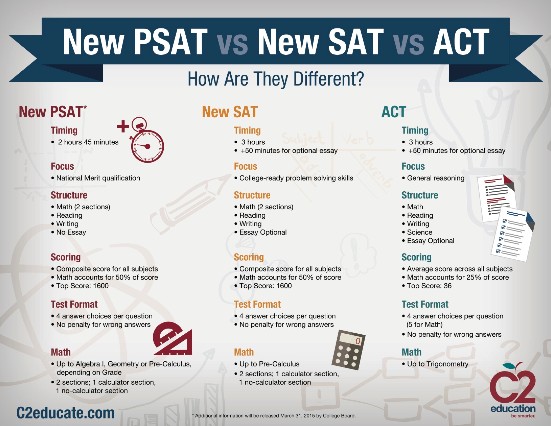
The 2018 PSAT is given to area high school juniors (and younger students in some districts) on Wednesday, October 19. But does this test really matter? Should you take it seriously? Is it something students should prepare for so that you do well?
Do Colleges Care About the PSAT?
The PSAT is not used directly by colleges and universities when they make their college admissions decisions.
Your acceptance or rejection into college is much more dependent on the SAT or ACT , so the short answer is “no,” colleges don’t care at all about the PSAT. An abysmal score on the PSAT will not have any direct effect on your chances of getting into a college.
When the PSAT Does Matter?
You definitely want to keep PSAT scores in perspective. A low score will not be seen by colleges, so even if you don’t perform well you haven’t hurt your chances of getting into a top college or university. That said, a strong score on the PSAT can have significant advantages:
-
-
- Your scores on the PSAT are used for awarding many scholarships including about 7,500 National Merit Scholarships, but to put National Merit into perspective: only a fraction of one percent of students become semi-finalists, and then only some of them see scholarship money. See more information by clicking here.
-