

Dorm Room Decorating – Conquer the Budget, Small Space, and Ugly, Standard Furniture!

What are the three biggest concerns facing college freshmen when it comes to setting up a dorm room? Working within a budget, coping with a small space, and learning how to manipulate the standard, ugly dorm room furniture.  So, what can you do to a room which you aren’t allowed to paint, with walls you can’t nail objects into, and two-of-a kind beds, dressers and desks? Learn more about how to make your space comfortable, bring a little bit of home with you, and create storage area which is essential.

Quick Tips for Those on a Budget!

  • Can’t paint? Use chalk to draw on the walls – you can erase it later with baby wipes or a dry eraser.
  • Try fabric on walls by using corn starch mixed with water. Apply the mixture to wall, smooth it out and watch how the fabric sticks to it. It’s all natural and comes right off without removing paint. This is an easy way to get color and texture in your room. Click here for tips on decorating a small, boring space on a budget.

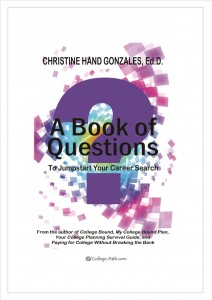
A Book of Questions to Jumpstart Your Career Search– Interactive eBook and Paperback Now Available!

Looking for a career change or a new job, but don’t know where to start? Thinking about an encore career? AreBofKwith borders lg you stuck in a rut?

“A Book of Questions to Jumpstart Your Career Search” was written as a resource to help students, parents, educators, and anyone entering or re-entering the job workforce. This ultimate resource tool is like having a professional career counselor beside you every step of the way. It will make you think about questions that may be important to you in your career search such as:

  • How Do I Get Started?
  • What Do I Do Next?
  • Who Can Help Me?
  • Where Do I Look For Information?
  • What Kind of Training Do I Need?
  • What Questions Do I Ask Before Choosing a Major?
  • What if I Change My Mind About My Career Track?
  • Where Do I Find Reliable Online Resources?

This book of questions is meant to be fun and thought provoking. So, discover how you really feel about your interests, skills, talents, and goals in life. One question will lead to another. Available on Amazon and in the College Path Bookstore. Click here for free down­loads Read­ing Apps from Ama­zon for PC, Mac, iPad, and other devices for Kin­dle Ver­sion. Click here for free down­load Read­ing Apps from Barnes and Noble for PC, Mac, iPad and other devices for Nook Version. Continue to read customer reviews!

10 Tips to Help You Pick a College Major

collegemajor[1]Have you spent hours sifting through college websites, touring campuses (both in person and virtually), and deciding where to apply for college?  Have you thought about what you want to study before choosing a college? As you weigh the pros and cons of every college or university you consider, think about which institution would be the best fit for you.

So what will you major in? Don’t panic! This is your time to test the waters. There are no wrong decisions. Some students know what they want to study and while others must try to figure out what career track fits.  Many undergrads change their majors during college, and even more graduates change careers throughout their professional lives.

Here are some tips to help you sort through the major selection process. Click here!

Reinventing Yourself is a Lifelong Process

Getting into the college of your dreams is a great adventure. Once there, studying hard, applying your talents, and using the skills you have learned up to that time will be exactly what you should be doing. Then you will graduate, and start on a career path that will be much different than the one your parents traveled. Your career will evolve as the world around you evolves through science, technology, and the changes in culture. You will need to evolve with it, and on the way you will become an expert. Just don’t be surprised if that expertise turns out to be in a different area than when you started.

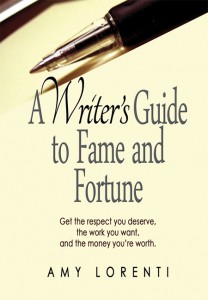
You may be an expert at something right now. Maybe you are an inventor, an artist, a writer of short stories. A great accomplishment and strong credential to add to your college application is “author.” If you’ve ever thought about writing a book, write one as an expert and tell someone how to do what you do Then self-publish. A new book by Amy Lorenti – writer, designer and digital media marketing expert – tells you how in A Writer’s Guide to Fame and Fortune – Get the respect you deserve, the work you want, and the money you’re worth. Check it out (available at Amazon.com in paperback and in Kindle books). Writing a book as a subject matter expert may just be the boost your application needs to get you into the college of your dreams.

I Need a Letter of Recommendation – How Do I Request One?

Colleges may require a letter of recommendation, or they may not. You will need to review what each school requires as part of the application. There are several people who may need to write on your behalf including your counselor and/or a teacher. Sometimes colleges will specify what they are looking for more specifically, like a letter from a teacher who taught you your junior year or one who taught you in a core course like English, math, science, history or foreign language. Review the following tips to help you get an effective letter of recommendation:

The letter should be from someone who knows you well.  He or she will need to be able to produce a well-written piece that will help the admissions office learn something new about you. Read more tips on how to request a letter of recommendation.

What are MOOCs and Can I Earn Credit?

Wikipedia defines a MOOC as:laptop home
A massive open online course (MOOC) is a type of online course aimed at large-scale participation and open access via  web. MOOCs are a recent development in the area of distance education, and a progression of the kind of open education ideals suggested by open educational resources.Though the design of and participation in a MOOC may be similar to college or university courses, MOOCs typically do not offer credits awarded to paying students at schools. However, assessment of learning may be done for certification.While there is no commonly accepted definition of a MOOC, two key features seem prevalent:

  • Open access. MOOC participants do not need to be a registered student in a school to “take” a MOOC, and are not required to pay a fee.
  • Scalability. Many traditional courses depend upon a small ratio of students to teacher, but the “massive” in MOOC suggests that the course is designed to support an indefinite number of participants.pedi

Scott Jaschik of InsideHigherEd.com shares breaking news about MOOCs.

Two announcements this week suggest that MOOCs — massive open online courses — will increasingly include a route for students to receive academic credit. Read the breaking news by clicking here.

Do I Need to Take the S.A.T Subject Tests?

SAT Subject Tests were developed by the College Board to measure the student’s knowledge or skills in a certain area such as math, history, physical science, literature, and foreign language.  These tests can be taken at any point in the student’s junior or senior year as long as they have completed the related course work in that subject area.

Many colleges use the SAT Subject Tests for admission, for course placement, and to advise students about course selection. Some colleges specify the SAT Subject Tests that they require for admission or placement; others allow applicants to choose which tests to take.  If you are presently taking an Advanced Placement course in one of the areas listed below, you may want to consider taking the Subject Test in that topic in May or June since you are already studying for the AP test. Click here for list of Subject Tests offered.